The Philosophical Excellence Behind a Bachelor’s Degree: Historical Foundations, Liberal Education, and Civic Purpose
“This article explores the philosophical foundations and enduring public value of a Bachelor’s degree. Far beyond its role as a vocational credential, the degree embodies a centuries-old commitment to the formation of the whole person—intellectually, ethically, and civically. Drawing from classical Greek paideia, medieval liberal arts education, Enlightenment ideals of rational autonomy, and modern liberal education theory, the Bachelor’s degree is presented as a structured pathway toward intellectual maturity, moral development, and lifelong learning. The analysis given in this article identifies four core pillars—intellectual autonomy, breadth of knowledge, moral and civic development, and professional capability—and situates them within historical and contemporary contexts. Ultimately, this article argues that the Bachelor’s degree remains a vital public good, essential for democratic societies, global citizenship, and human flourishing.”
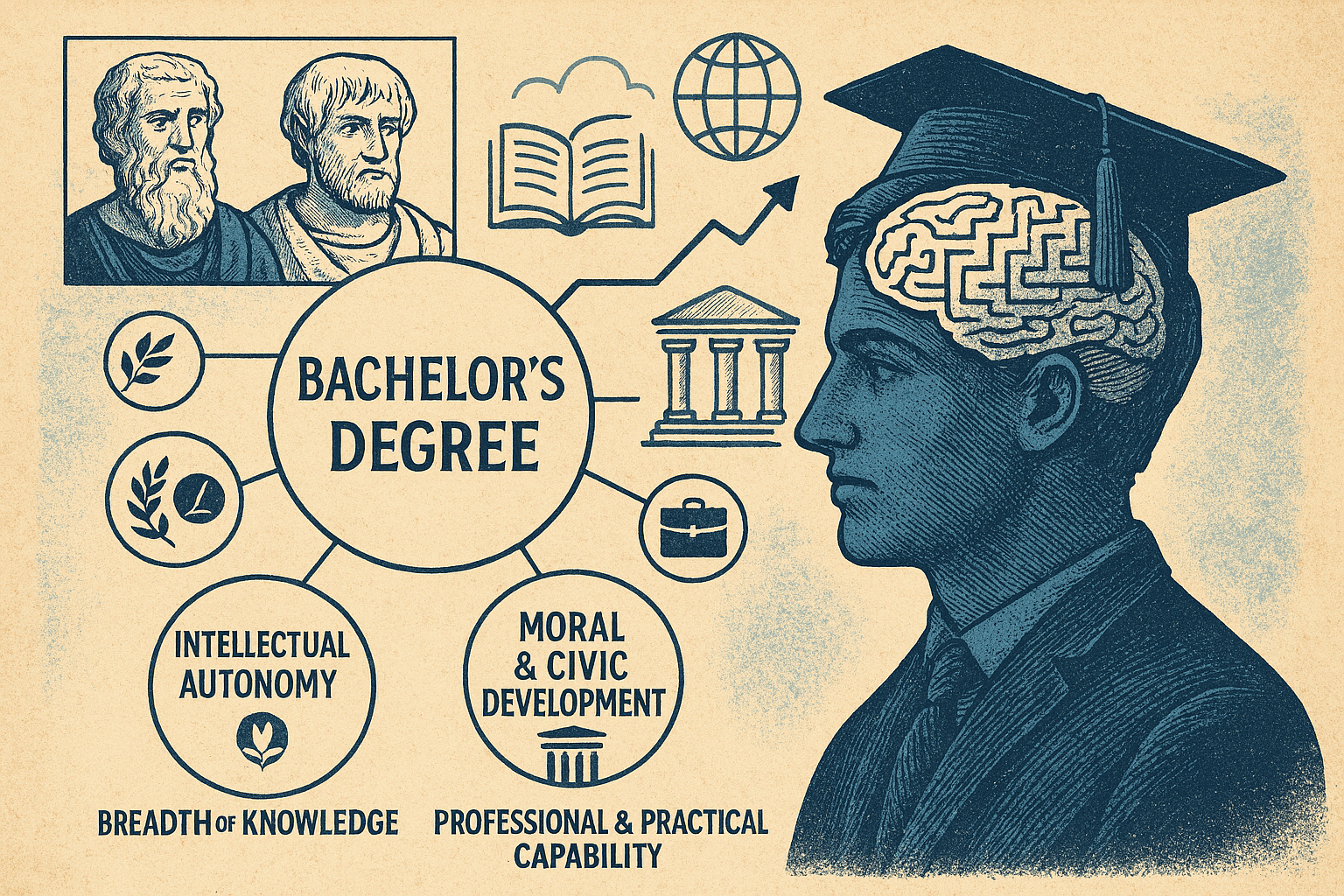
Bachelor’s Degree and Philosophical Excellence
Abstract
The Bachelor’s degree is widely recognized as a foundational academic qualification, yet its deeper purpose is rooted in a long philosophical tradition concerned with human flourishing, intellectual autonomy, and civic responsibility. Drawing on classical Greek paideia [1], medieval university structures [4], Enlightenment rationalism [8], and modern liberal education theory [2], [5], this document argues that the Bachelor’s degree represents a structured pathway toward intellectual maturity, ethical development, and lifelong learning.
1. Introduction
The Bachelor’s degree is often viewed primarily as a credential for employment. However, its philosophical foundations reveal a broader purpose: the formation of the whole person. This idea is grounded in classical, medieval, and modern educational traditions that emphasize reason, virtue, and civic participation [1], [3], [7]. The goal of this document is to articulate the philosophical excellence behind the Bachelor’s degree and explain why it remains a vital public good.
2. Historical Foundations of the Bachelor’s Degree
2.1 Classical Greek Origins: Paideia and Human Excellence
The philosophical roots of the Bachelor’s degree begin with the Greek concept of paideia, a holistic model of education aimed at cultivating virtue, reason, and civic responsibility [1].
Plato emphasized the formation of rational judgment and moral character, arguing that education should lead the soul toward truth [1]. Aristotle similarly held that education should cultivate arete (excellence) through habituation and rational inquiry [3].
These ideas established the principle that education is not merely technical training but the shaping of a capable, ethical human being.
2.2 Medieval Universities: The Trivium and Quadrivium
The first Bachelor’s degrees emerged in medieval Europe, where universities structured learning around the trivium and quadrivium [4].
The Trivium
Grammar
Logic
Rhetoric
The Quadrivium
Arithmetic
Geometry
Music
Astronomy
These disciplines were believed to cultivate the intellectual virtues necessary for higher study and responsible citizenship [4].
8. References
[1] W. Jaeger, Paideia: The Ideals of Greek Culture. New York, NY, USA: Oxford Univ. Press, 1945.
[2] B. A. Kimball, Orators and Philosophers: A History of the Idea of Liberal Education. New York, NY, USA: College Board, 1995.
[3] R. E. Macklin, “Moral Education: Aristotle Revisited,” J. Med. Philos., vol. 6, no. 1, pp. 87–91, 1981.
[4] W. J. Ong, “The Bachelor’s Degree: Its Exponential Ingredients,” Engl. J., vol. 48, no. 8, pp. 443–452, 1959.
[5] M. S. Roth, Beyond the University: Why Liberal Education Matters. New Haven, CT, USA: Yale Univ. Press, 2014.
[6] M. Nussbaum, Not for Profit: Why Democracy Needs the Humanities. Princeton, NJ, USA: Princeton Univ. Press, 2010.
[7] J. Dewey, Democracy and Education. New York, NY, USA: Macmillan, 1916.
[8] I. Kant, “An Answer to the Question: What is Enlightenment?,” 1784.
[9] P. Freire, Pedagogy of the Oppressed. New York, NY, USA: Continuum, 1970.
[10] A. MacIntyre, After Virtue. Notre Dame, IN, USA: Univ. Notre Dame Press, 1981.
[11] E. O. Wilson, Consilience: The Unity of Knowledge. New York, NY, USA: Knopf, 1998.
[12] H. Gardner, Frames of Mind: The Theory of Multiple Intelligences. New York, NY, USA: Basic Books, 1983.
[13] J. Bruner, The Process of Education. Cambridge, MA, USA: Harvard Univ. Press, 1960.
[14] A. Bloom, The Closing of the American Mind. New York, NY, USA: Simon & Schuster, 1987.
[15] UNESCO, Education for Sustainable Development Goals: Learning Objectives. Paris, France: UNESCO, 2017.
